Archive for the ‘Uncategorized’ Category

the picture.

Posted: July 23, 2013 in Uncategorized

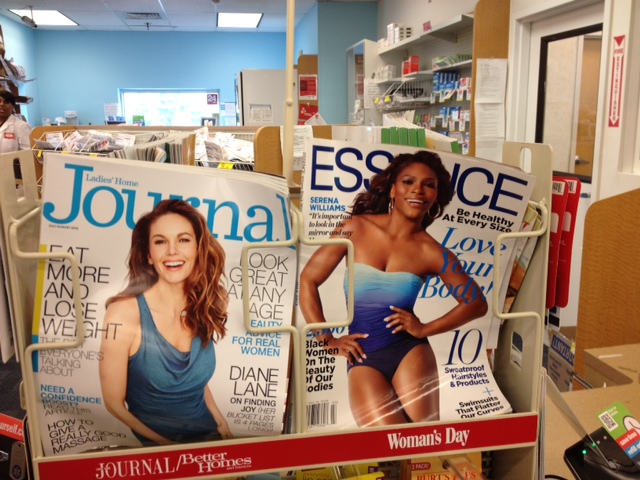
It started with this picture.  This one, right here.
body race

Leaving aside the lack of other magazines on the shelves with people of color (I looked, and every other glossy had a white lady on the front), this juxtaposition has been haunting me.

I love buying magazines like Essence, because it’s so different from traditional magazines that are marketed to women.  Thinking about Cosmopolitan, People, Women’s Day, Redbook, Vogue etc., there is something radical about putting the words “love your body” on the front of a magazine without a diet tip section next to it.  Especially when the magazine next to it has a skinny white lady with “Look Great at Any Age” and “Eat More and Lose Weight.”

I discussed my feelings with one of my black friends, after showing her the picture.  She told me that black women have to love their curves “because they’re not going anywhere.”

There is an abundance of information and articles about the intersection of racism and body image.  I am in love with the idea of natural bodies being loved, enjoying differences in shape and appreciation of larger women (my own bias, no doubt, as a larger woman).  More in depth analysis can be read HERE  and HERE and HERE for background.

Conflict and problem for me stems from the idea that only women of color can appreciate their bodies as they are, that only women of color have curves “that aren’t going anywhere.”  My argument isn’t overtly about black versus white, it’s another permutation of the long standing idea that white women are supposed to look a certain way versus women of color.

There is a long history of racism at work here, and I’m unable to speak from my experience, as I come from a place of privilege as a cis, able-bodied, white woman from a middle class home.  However, to change these attitudes we woman need to work together rather than against each other, toward appreciation of all bodies.  We need to understand the science of weight, that our bodies resist change, and that healthy people exist in all sizes.  Love your body.

chubby chasers.

Posted: May 31, 2013 in Uncategorized

I’ve been dating people in and around the punk rock scene for a little under 10 years now, and I’ve been noticing more and more this insidious expectation.  I’ve had more than one boyfriend tell me they love my body or love my shape, and while that’s fine, I could never figure out why it sort of rubbed me the wrong way.  Why did they feel it was necessary to comment on my body?

I gained some clarity on my discomfort a couple years ago, when I overheard a boyfriend’s mother talking to her friend about how he was a “chubby chaser.” I remember very clearly the flush of shame I felt, how much I felt I was defined by my body.  And that is the problem.

So much time we spend talking about how we shouldn’t be definted by our bodies, how our bodies are simple vehicles for our minds and our personalities.  Much is made of the effort to remind society that all bodies can be beautiful and attractive.  But somehow, the effort has spawned this idea that dating a “fat chick” is some sort of statement against society.

I am not a counterculture statement.

You do not date someone to prove a point.  You do not date someone to prove how anti-society you are.  You do not date someone because you think you shouldn’t date what you are expected to date.

Date the people you like, who you are attracted to.  I am not a counterculture statement.  And to make me one is to perpetuate all those standards you claim to hate so much.

on anorexia.

Posted: May 15, 2013 in Uncategorized

on the eating disorder scale, anorexia was always fascinating to me.  all eating disorders are about control, but this one was control NOT doing things, where bulimia was more about being out of control then retaking it.

via feministing.com, a personal look at anorexia.

diets, parents, restricting, outside control.  carl rogers, father of humanistic psychology, built his theory on the idea that our problems come from outside “conditions of worth” placed on us from outside sources, parents, friends, society etc.  it’s times like this when life proves the theory right.

So like many people who are putting thoughts out there in the vast internets I read a number of different blogs and news sites, and it seems in recent weeks there is a growing trend of pieces discussing street harassment.

Street harassment, that time honored tradition of yelling at people (majority women) who are simply walking down the street or going about their business, has been coming under fire, most notably from Project Hollaback.  Take a look for a brief primer on street harassment (link to video with animation) and how it is viewed by men  and women.

Community mental health centers usually operate in the most dangerous parts of the city, where there is (usually) the most need.  Those streets where people without homes gather, where shelters are, where churches pass out sandwiches at 11am and pharmacies give away drugs with vouchers, these are the areas where CMH is king.

My colleagues and I walk to my office from a gated parking lot.  We walk past a homeless shelter and the alley between the shelter and our building.  Each day when leaving the car, there is a moment I take to brace myself for the walk.  Head up, eye contact, shoulders back.  Do not engage, just nod and say good morning.  Because each day there are men (and women) who will try to engage or at least make comments.

The woman in the office next to mine told me she feels fearful each time she leaves her car and when she leaves the office at 5pm.  She states she feels harassed and every day has someone say something to her, usually focused on her body.

I have the same experience, but feel little fear.  I’m not sure if it’s because I started my career in mental health at a residential facility full of male parolees/probationers, who rake each female employee over with their eyes any chance they get.  It was a write up there; usually if one is a counselor, one’s own clients would stick up for their own counselor (“don’t look at her that way, don’t say that, that’s my counselor) and the counselor would take a moment to explain to whoever was doing the looking that it was inappropriate.

This sort of ogling was so entrenched at that center that being on the street where the worst I’ve heard is “you look so pretty today” is really no big deal.  But I also found myself thinking in a bit of a twisted way…I felt jealous of my colleague.

Let me be clear – street harassment sucks.  It reduces women to their bodies only.  It’s totally dehumanizing.  And it’s unsolicited; I doubt most women are getting dressed up to get leered at and hassled on the street.  Comments are not needed for validation, especially not from strangers.

Oddly enough, however, it is a sort of confirmation, an affirmation that one is desirable enough to elicit these comments.  I often talk with my mother about older women and their invisibility in our society (more on that here) but women who don’t fit normal standards are often invisible too.

Body type, race, age.  When we get harassed on the street, does that make you feel just a little bit different?  Like you’ve still got to deal with all the bullshit other women do?  Does it unite us in anger and hatred and a thirst for justice?  And how does it make those women who do not get harassed feel?

Confession: I never worried about being raped in high school or college because I wasn’t thin (and at that point did not consider myself even remotely attractive).  This, of course, did not stop my experiences with sexual assault, and its been shown over and over that appearance has little to do with rape.  And yet, my attitude was so warped, so distorted, and I wonder if I still have a little bit of that.  When I get yelled at and feel a little validated and a lot irritated, is that validation a remnant of my attitude?

thin as privilege.

Posted: April 8, 2013 in Uncategorized

Throughout my work thinking about and looking at research on body image and psychology, there has been an interesting theme of privilege which has emerged.  Privilege and I were first introduced during my time in graduate school, to assist in the understanding of racial injustice.  Any privilege is a complex issue to understand, and can best be understood as benefits through no fault or merit of your own, as a result of systematic valuing of your own characteristics over someone else’s.  White privilege, straight privilege, male privilege, American privilege.

Putting body weight in this category is controversial, as it should be.  Research is still spotty on the truth or changeability of ideas about body weight set points, the efficacy of diet and exercise, medical interventions and different body types by genetics.  It’s a wonder body weight is even being considered at all.  Most health care offices one enters (including my own) have signs reassuring clients they will not experience discrimination as a result of race, ethnicity, gender, language, sexual orientation, [sometimes] ability to pay.  Does weight belong there?

I grew up and have been trying to organize my thoughts on the matter for years.  Having begun writing and expressing my own thoughts on the subject, it has again become salient for me.  This piece from The Frisky does it better than I probably could.

I am a size 10 or 12, so I feel the same way.  Although I am not thin, I have begun to take my own privilege into account.  Recovery is for all sizes.

For now, enjoy pictures of fat women in bikinis (not real women, because as we’ve discussed, we are all real, no matter the size).

florida and bikinis.

Posted: April 3, 2013 in Uncategorized

There is no place like Florida for dealing with body image.

(Prompted by this recent comparison of unphotoshopped Victoria’s Secret model Alessandra Ambrosio and photoshopped version.)

I used to lecture on sexual objectification and body image to female clients working to overcome addiction and criminal history.  We would talk about photoshop and media savvy; I would show them the pictures of the famous Redbook modifications of Faith Hill and we would discuss the body beautiful in every form.  It’s easy to forget that the real world still exists when you rip out magazine pages all day.

On my recent jaunt to Florida I was wearing a bikini, no small feat for me, but something I’ve been working up to for years.  It was a surprising pleasure walking along the beach.

As a self-conscious and miserably overweight teenager I usually spent trips to Florida huddled in a towel or under the water, dreading my mother’s enthusiastic trips to the swimsuit store where I would have to walk past the racks of string tied tops to the old lady one pieces in the back.  I would sit on the beach miserable, watching other girls and women walk by, thinking about how I would know I had finally made it when I could do the same.

Somehow, as a teen, I missed the lack of uniformity among these women.

On this trip, as I (mostly) confidently walked around with my stomach showing, I noticed the wonderful and totally real assortment of women on this beach.  We stayed in Siesta Key, south of Tampa, and despite this being a spring break trip, there was little fodder for a frat movie to be found.  Tanned and taut teenagers were there in force, but they were far from the only people.  Older women.  Extremely thin women.  Large women.  Women with C-section scars.  Women with bellybutton piercings and faded tattoos, women in pink and in oddly cut suits, wrinkled women, white women, tanned women.

Although it was clear to me that this experience was geared towards the middle class white suburban family (especially evidenced by the fact I saw only 2 black women my whole week), this experience was enormously corrective for me, and for that awkward 14 year old girl still huddled in my head somewhere.  To see all these bodies on display, with little self doubt.

Just for a second, let’s take a second and give it up for Florida.  Putting women and men in bathing suits with each other, FOR REAL.


fat as political.

Posted: March 25, 2013 in Uncategorized

now i’m not sure how many feminists are in the house, but for those who aren’t familiar, let me give you a 5 second summation of the movement: the personal is political.

when it came about this was revolutionary and it continues to shape the way we move, fight, conceptualize, write, think.  recently there were two articles that brought the importance of personal issues into the public sphere.

the first is from chloe at feministing.com, discussing having an eating disorder and being a feminist writer.  the second is a response to the piece, and puts forward the idea of gaining weight as political.  they are best read sequentially.

its hard to write about these issues and have a concurrent eating disorder.  i started my eating disorder therapy last week, for the first time in years, and i found myself struck dumb when i was asked if i was “restricting.”   wait a second, i found myself thinking. i’m not thin, that’s a question for anorexics.  and yet, the question remains.  am i restricting?

this is a better but a more loaded question than using words that are accepted in our culture, works like “dieting” or “cutting back” or “trying to avoid [eating this].”  yes, i am restricting.  i don’t know anyone who doesn’t, in the back of her head, think at least a little bit about what is going into her mouth.  but maybe that’s part of the problem.

and i, like the woman who was brave enough to write the second piece, don’t want to admit that my eating is still disordered, because i’m now getting more compliments and attention than ever.  my mother told me i have “such a cute little body now.”  my self-esteem is apparently still tied to my body, even though i know i’m not “supposed” to do that.  and to stop restricting – is that to give up on the idea of being thin forever?

it’s a terrifying concept, and one that speaks to addictions of all kinds.  picture the alcoholic thinking about giving up going to the bar forever.  this is why 12-step groups focus on “just for today”, a concept less terrifying than forever.  but can just for today turn into political protest?  is being fat, or voluptuous, or thin, or very thin, political?  is being fat in a magazine political?  is eating how you want without worry political?

i think it is.  but getting there personally is a struggle we all fight alone.

prevention and potato chips.

Posted: March 16, 2013 in Uncategorized

It was while I was sitting on an airplane flying home from Texas that I had another moment of truth.  I was traveling with a friend and she nudged me and pointed to the woman sitting in the row next to us.  She looked to be somewhere in her forties, blond hair, next to a significant other of some kind.  We had seen them share pizza earlier in the flight, and my friend had noticed this woman was reading a prevention magazine while eating potato chips.

 

We both had a hard time figuring out why exactly this hit us as being funny.  It was funny like a person sitting on the couch watching Tae Bo DVDs.  Or Liz Lemon walking on a treadmill while eating an ice cream sundae.  Why?


Personally I try to avoid health and fitness themed magazines about as vehemently as I avoid celebrity gossip; critiquing bodies of famous people next to chocolate recipes next to diet tips tend to make me a bit irate.  The beautiful juxtaposition of the magazine and the chips worked to underscore how absurd these magazines are.


Growing up I was told by either my mother or another significant relative that no diet or pill or exercise is actually magically effective.  If such a thing existed, we would know about it, because the creator would be millionaires and we would all be taking it.  Every month when I read about the flat belly diet or the next big exercise to make your abs appear or your butt tighten or whatever, whatever’s going to fix the newest and most hated parts of our body, it’s absurd to think anything will actually be that effective.  Sometimes you just have the body you have.


A while back I read this article talking about how people get frustrated because they don’t understand that weight loss and fitness are hard work and don’t come within three months or weeks.  It’s unfair to blame this on people.  Magazines and shows and diet books make money by promising the quick fix.  For some people these tips and tricks really do work (although as someone whose whole family is big in the middle, I have doubts about the effectiveness of the flat belly diet etc).  but I go back to the woman eating chips and reading about fitness.


Is part of this like The Secret effect where we visualize change and it happens?  No doubt a large portion of the issue is our refusal to acknowledge the existence of differing body types and how effective dietary and exercise changes will be.  Sometimes you have the body you have.

Why is this phenomenon so funny and so jarring?

addictive food.

Posted: March 3, 2013 in Uncategorized

ice cream sundae resepas i was in my kitchen this morning, slowly losing control of my eating, i was thinking about the idea of willpower.

i’ve worked in addictions my whole career and alcohol and drug addictions are frustrating.  there is so much relapse, so much lack of control.  at the heart of it i was always fairly jalous.  alcohol and drugs are ridiculously addictive.  but at the end of the day, there is no cocaine in your corn flakes.  you don’t have to drink alcohol to sustain yourself.  i was jealous of their ability to just give up their addiction, to avoid it.

this morning i was reading this article by david katz about food being addictive, and it makes instinctive sense to me.

if we have an addiction to something you need to live, is there ever recovery?

As I was reading one of my favorite blogs this morning, The Pervocracy, I was pleased to find she had written her monthly article mocking Cosmopolitan magazine.  There was a terrific line in the article that crystallized some of my thoughts on the idea that girls have to call themselves fat:

Your guy knows you’re not fat.  He can see you’re not fat.  But the more you say you’re fat, the more he’ll start to question the evidence.

But I am fat.  I’m not being self-deprecating or whatever, I’m just being… roundish.  And I don’t think any combination of words would cause a person who sees me naked to question the “evidence” that my body is the size and shape that it appears to be.

Of course, this sentence makes perfect sense if you understand “fat” to be a word with absolutely no relation to a person’s weight or size, but simply an insult of their worth and sexual appeal. [emphasis mine]  Which seems to be the thing these days.  Kind of painful if you also happen to be roundish, but I don’t think “not being painful” was a priority in this process.

In a nutshell, calling someone fat does not mean that objectively they have a fat body.  It means they are stupid, worthless, less than.  No longer attractive.  No longer worth our respect or consideration.

The reason that it’s so hard to argue with the insult of being fat is because it’s not an objective fact you’re arguing against – it’s the idea that you are less than now.  You can’t argue with facts because this argument isn’t rational.  Just like you can’t argue with a racial slur.  Or being called a bitch.   It’s the reason that in middle schools and dressing rooms around the nation you hear frantic protests of “no you’re not!” when women complain about their weight – because being fat isn’t about your body.  It’s about being awful.  And  we have to frantically fight against the idea and provide reassurance, not about your body, but that you’re still worth something.