Archive for the ‘Uncategorized’ Category

The horrific attack in France that left 12 people dead have whipped the internet into a furor.  Suddenly, people are talking about freedom of speech and discussing responsibility.

If you live in the United States, you exist under a law cementing your freedom of speech.  It is your right to say what you want, with exceptions for inciting folks to harm, libel and hate speech.  Hundreds of thousands of papers have been written analyzing the impact of these laws, to prevent chilling effects and ensure citizens and media have their freedom.

People don’t get freedom of speech because of the nature of people.  Almost without exception, we like and support people who believe and speak as we believe and speak, but get upset and angry with people who express views and ideas running counter to our own.  We have the law to protect us AND the people whose views we despise.  To paraphrase the great Andrew Shepard (sorry, an old white dude president, but I love this flipping speech), uphold the rights of someone whose views you would spend the entirety of your life shouting against.  Celebrate that in your classrooms.

It is this freedom that protects bands that I won’t even link to, bands promoting racism, homophobia and misogyny.  And we react not by banning those bands’ ability to make music, but by not buying their material, not supporting their tours, and writing and releasing music supporting values we believe in.

The solution to speech is more speech, speech promoting what you believe, or in opposition to what you do not believe.  (side note – it’s out of the scope of this blog, but there are important exceptions for hate speech, which significantly impacts people and is banned under the 14th amendment, providing all equal protection under the law).

Both terrorist fundamentalists and our media talking heads lose their focus here.  If you don’t like what’s being said, TALK MORE.  Act more.  Protest more.  Don’t kill people who don’t share your views.  Bans, rules and fear will not change people – they will never see things your way from being afraid.  DEATH SHOULD NOT BE A CONSEQUENCE OF SPEECH.  But, it is.  Often.

Even when the said speech sucks.  Even when it’s offensive to us.  Death should not be the consequence, and expressing our empathy and compassion for those lost in the attack does not equal agreement with what was published.

Reporters, bloggers, writers, artist, musicians, citizens – do not give in.  Do not let fear and oppression rule the day, but do not use our ability to speak as a carte blanche stamp to say whatever the hell you want.  We have a unique opportunity to show solidarity and support to those in France who made their views public, at great risk to their own lives.  We also have an opportunity to use our speech to condemn both the newspaper’s racist cartoons and the terrorists’ act of violence which cost lives.

Now is the time to stand up for the right of all to speak freely and disagree freely.

(image via)

This morning NPR actually blew my mind.  Thomas Piketty, a person I had never heard of, is now my hero.  Why, you ask?

Piketty is a French economist, and France’s government was going to honor his achievements with an award called the Legion of Honor.  He turned it down.  Why, you ask again?  BECAUSE THE GOVERNMENT SHOULDN’T BE DECIDING WHO IS HONORABLE!

this guy, right here. hell yeah.

I fist pumped in my car, shouting “hell yeah!”  Because that’s awesome!  Here is a dude who is practicing what he preaches, actually acting on his ideals and beliefs!

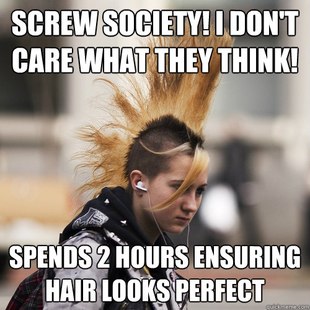
Me being me, I had two thoughts occur after hearing this story.  Posers are the scourge of the punk rock scene; as SLC Punk put it, “they’re people who dress like punks but do it for the fashion!”

People who don’t actually act in line with what they’re presenting to the world, people who pretend to know or be something they’re not.  Posers.  And Piketty is the ultimate anti-poser.  Seriously, Green Day just got inducted into the Rock and Roll hall of fame.  For a band that calls itself punk (even though we all secretly know they’re terrible), that is super fucking lame.  Hall of Fame?  Punk is about blowing that shit up, about destroying all of that.

Secondly, the reason PIketty totally rocked my socks off has to do with a study in psychology on conformity.  A dude named Asch did a (now) famous experiment after World War Two, when most social psychologists were trying desperately to understand how “normal” people had done such extraordinarily evil things.  He put a man in a group of “confederates” (people working with the researcher), then showed the group pictures of lines with different lengths and asked them to decide which lines were the same lengths.

The group insisted the wrong lines matched, and here’s the thing – the man placed in the group usually went along with it (about 75% of the time).  It’s SUPER hard to go against the group, even when you know that what you’re agreeing to is wrong.

So props to you, Piketty. You’re a man of ideals, with the courage to go against what most people would probably accept.

those joe boxer ads, though.

Posted: December 26, 2014 in Uncategorized

Sexualizing women’s bodies is the bread and butter of most American media and commercial advertising.  No, really.

See? WTF!

Sexual objectification is complex, but usually detectable through these seven signs:

1.  The image only shows parts of a (sexualized) person’s body

2.  Sexualized person presented as “stand in” for an object

3.  Sexualized person shown as interchangeable with other(s)

4.  Image affirms the sexiness of violating the body of someone who cannot consent

5.  Sexual availability is the defining characteristic of a person (emphasis mine)

6.  Sexualized person is shown as a commodity – something that can be bought or sold

7.  Sexualized body used as a canvas

(Activity: go through any magazine, and you’ll see 99% of it is sexualized bodies, mostly female bodies.  I dare you.)

Pregnant bodies are traditionally viewed as “other“, as un-sexual, as something we must not find sexy.  This is also a reasoning used to scorn and degrade fat bodies; the only two kinds of bodies we’re not allowed to find sexy are big and bigger.

A fascinating study from a few years ago posits this position comes out of a fundamental rejection of female bodies taking up too much space – to be feminine is to be small, delicate, chaste, virginal, juvenile.  Plus, pregnant women are women who have (gasp) had sex, obviously, which is also a rebellious act.  We looooooove small, skinny, wealthy white women – just look at celebrity magazines touting easy ways to lose your baby weight FAST, showing (white, rich) women whose only weight is in their belly.  The fuck?

Pure garbage.

Whatever your feelings toward pregnancy, I’m confident we can agree about the overarching sexualization of women and girls has negative effects on our culture (and produces lazy, shitty music and media).  With this in mind, I present this balls-awful Joe Boxer ad I saw yesterday (I don’t watch a lot of TV, don’t judge).

http://www.youtube.com/watch?v=N94ES_HI-K8

What the fuck is this shit?  You’re sexualizing female pregnancy to sell me a shitty pair of pajama pants?

Women have a right to feel however they want in whatever bodies they have.  The media needs to stop telling us what to do and how to do it.  STOP!

Music as Identity

Posted: December 18, 2014 in Uncategorized

As embarrassed as I am to admit it, I listened to a Casualties song on the way to work today.

I’m sorry.

Never my favorite band, the Casualties earned my ire (and the ire of the all powerful internet!) after allegations surfaced about poor conduct by the lead singer of the band.  But that is not the subject for today.

What my shuffle came to this morning was a song called “Diehards.”  Here, this is the video for it:

http://www.youtube.com/watch?v=tjOkJCWZqzU

For those of you too cool or respectable to watch YouTube in the middle of a Thursday afternoon, let me sum up by restating the song’s chorus “We are punx!”

I was thinking of how much punk connects with identity in those who listen to it (or are “in the scene”, as it were).  It’s part of the reason punk is viewed as a musical phase, something people grow out of listening to.  It’s got a dress code (yes, even your weird proto-hippie crust band) and a general code of conduct.  Even when punks punx disagree about what’s important, we generally have some similar values and ethics.

So, you’ve got your cred.  You stud and paint your own leathers, you taught yourself to (badly) play the drums, you drink the finest malt liquors (or not) and you rent a room in a house with ten other like-minded people.  Now what?

Punk was started by groups of people who were so frustrated and angry with the system as it stood, they created identities, art and culture in opposition to mainstream culture.  One of the clothing labels I’ve seen most often is “No Future.”  There’s a million songs about how there’s no future for us, that life is for the young…so what happens when we grow up?  What happens when we’re 30 and 40 and 50 (and 80) and our backs hurt from stage dives, our teeth are rotten because we can’t afford health insurance, we’ve got fifty bucks under the mattress because we don’t trust the banks and can’t hold a job?

See: Shane McGowan, former lead singer of the Pogues

It’s always hard to change your identity (there’s even a branch of therapy specifically devoted to it, called narrative therapy).  Anyone who’s come out as LGBTQI, anyone who’s made a life in a different country, or even gotten a divorce, can tell you about the anxiety, fear and disillusionment that comes when you change an integral part of who you are.  We don’t have to be conformists or buy into the capitalism, consumer driven bullshit to live meaningful punk rock lives.  You might never be Joe Strummer, trying to make changes from the stage on down.

I believe our only hope is to channel the rage, disillusionment and innovative creativity present in our music and culture, and put it to work.  It doesn’t really work to say “fuck the system” if you can’t create a better system (as Ben Harper sang, “what good is a cynic with no better plan?”).  It doesn’t matter if you think the world is unjust if you coast through that world.

Okay, so you care about (issue here).  What are you going to do about it, punk?

Fuck You, Ice Cube.

Posted: November 21, 2014 in Uncategorized

Last night I watched 22 Jump Street with a friend.  Ashamed as I am to say it, I loved the first movie – it changed my opinion of Channing Tatum (handsome lunk) for the better.

In this movie (SPOILER ALERT), Doug (Jonah Hill) and Brad (the hotness) are put into a state college to ferret out a dangerous drug and supplier.  It’s presented in much the same way as the plot of the first movie.

In the course of their undercover work, Doug meets a woman who he likes (surprise!) and in the course of hanging out and making friends, has sex with her.  It is presented as consensual and positive (although, hilariously, he states “I’m not the hit it and quit it type; I’m more the hit it, keep on hitting it, on a physical and emotional level, type” after she tries to kick him out).  When he gets back to the police station, as an excuse for not having new information about his case, he explains he “got laid” and got high fives from his colleagues, including his boss, Ice Cube.

On parents weekend, he learns Ice Cube is the father of the girl he had sex with.

He made this face, right here, for at least 5 minutes.

Hilarity (kind of) ensues; Ice Cube is angry, throwing things around, glaring at Doug, sending threatening text messages (including “you’re a dead man “Doug”).  This drove me kind of bonkers, but I couldn’t figure out why.

It came to me this morning.

Fuck you, Ice Cube.  You create and encourage the kind of environment where women are conquests, prizes to be won, marks to be taken.  You are a part of a place where high-fiving for getting laid is acceptable and encouraged.  You broke your scary, angry boss exterior to support a conquest, yet when it’s your daughter suddenly it’s not ok?

You want different things for your daughter, but support systems and attitudes (in a workplace where you hold power to make changes and form attitudes about sex) that ensure things won’t be different.  If you’re okay with a sexual escapade, with it being a conquest rather than an intimate, meaningful encounter with another human being, you’re okay with your daughter being less than a person.  It is NOT okay for you to be angry and upset when your underlings act in accordance with your values.  It is NOT okay to punish your daughter and those around you with your anger, when you created the very environment needed for him to “get laid.”   (Is there a reason we don’t see many female officers in this space?)

You can’t pick and choose who you treat like a person.  You can’t decide women are meaningless and worthy of a high five, then realize you’d like your daughter treated as a whole person with hopes, thoughts and dreams.

And by the way?  Your daughter’s sexual activity is none of your damn business.  Her purity and virginity are no longer selling points or your property to oversee.  If she is a whole person, she gets to decide who she has sex with.

It made me mad because this sort of behavior, being fine with treating human beings like shit unless you know them personally, is normal.  It is everywhere.  It’s the dude talking about bitches, unless it’s someone’s sister and they say “not cool, bro, that’s my sister.”  Like your personal relationships with women are the ONLY THING MAKING THEM WORTHY OF RESPECT AS WHOLE PEOPLE.

If you’re going to be that angry, stop enforcing these sexist, patriarchal attitudes.

(P.S. This is made worse by Channing Tatum’s insistence on calling out the drug dealers for calling him a “faggot”, yet dies laughing about the sexual conquest and only refers to women as “hot” and calls other people “pussies” all the time.  God damn it!)

When I first started therapy, at least this round of therapy, I immediately got into a fight with my therapist about drinking.

As a substance abuse counselor for many years, I am well familiar with the symptoms and signs of problematic use; my issue was her assertion drinking causes mood disruption for almost a month after the drink.  One drink?  Depressed for a month? Sounded a bit loony to me, especially as I’d never read anything in the literature matching this assertion, with the exception of those who drank every day, then suffering withdrawal and PAWS.  So I did an anecdotal, totally unscientific study and stopped drinking for 45 days, tracking my mood each day.

Through this time period, my parents invited me to visit them on vacation in Florida, I was living with roommates with whom drinking was our main activity, and I was single and working three jobs.  Surprisingly, it wasn’t that hard to say no to booze (it’s always nice to have a reminder that I really can stop if I want) and drinking club soda usually solved the problem at bars, as it looks like it could be a drink.  But my mood stayed the same.

(Depression and alcoholism (as well as other drug use) usually go together.  They do not help each other.)

I have never been hungover and told myself I would never drink again.  For one, that’s an absurd cliche.

For two, I knew it was baloney.  Sure, I wouldn’t been tossing shots back the day after a big night, but forever is a long time (hence the one day at a time motto in AA).  But as I grow older and older, I am drinking less and less.  My tolerance is down, and I don’t find myself out on Friday and Saturday nights, spending money and carousing.  I have fewer hangover brunches, and my fridge keeps beer in it for weeks at a time (it helps not having roommates).

I struggle, because in the states especially, it seems drinking is associated with being young, being in college, with fun, with cutting loose.  I worry I am getting too serious, that I am losing friends, that worst of all, I may be growing up and out of the party scene.

yep.

It’s this that is most difficult, because really, drinking is putting a neurotoxin in your body.  It has calories, makes you do stupid crap (sometimes) and it destroys your body if you drink enough for long enough.  I have friends in their forties who party like college students, and my parents definitely drink with their friends on occasion.  It’s these thoughts and experiences that make you sympathetic to anyone in recovery, anyone who has chosen to make changes in their life and put the bottle down.  Because even for us weekend warriors and college boozers, it’s not easy to stop.

This article states an alcoholic is anyone who’s life gets better when they stop drinking.  Does yours?

talents and privileges

Posted: October 29, 2014 in Uncategorized

When I was a child, mom used to take me (and later, my little sister and me) to church. We were raised Lutheran, and raised in a very small church; my confirmation class had three people in it, including myself. I continued attending church until I graduated from high school, mostly because it was normal in our house and because I was a part of the choir, which I loved.

Black_Harlem

I stopped going to church at age 17, and haven’t been since, with unfortunate exception for religious funerals.

One sermon that still sticks with me, one of maybe five, is one of the talents. In this sermon, we were told god gave three people talents (money), and given two weeks to grow these talents. One person buried their talents, one person lost his, one person invested and doubled their original gifts. God was said to love the latter two most of all, because they worked to do something with what they were given

However, this morning I was watching some documentaries (my solution for boredom during my bouts of insomnia), including one (mediocre) called “The One Percent” and one (outstanding), “The Black Power Mixtape”, thinking about privilege.   In a lot of ways, privilege is like the old story of talents.

Your skin color, your class at birth, your family of origin – these are things over which we have no control. We do have control over what we do, especially those born into privileged classes, racial strata etc. If you are born white, you can’t change and decide to be born black. You can choose to use your privilege to give opportunity to people who may not otherwise have a voice.

People who think this way need to burn for justice. We need to speak louder, use our place and our voices to amplify those marginalized by oppression. We need to remember our history and learn the lessons of Malcolm X, of Attica prison, of the Soledad brothers, of Angela Davis, of bell hooks. This is not anti-American. This is pro-American people.

When our time here is done, and we are asked what we have done to make this world better with our privilege and talents, how will you answer?

Okay, the title is way more important sounding than this post will be, but bear with me.

veeeeeery important.

Last weekend I was in another state and became very ill.  Severely ill.  Like, three days of nastiness.  While the cause of my disgusting escapades is still unclear (most likely alcohol + woman times + flu), the whole thing got me thinking about sickness and who is in charge of you when you’re sick.

While I was (embarrassingly) throwing up outside of a restaurant at which I was attempting dinner, a friend came to me and continued to insist I “slam water, water is what you need.”

Now, this is fine advice.  And probably accurate; being sick is amazingly dehydrating.  But it’s not really a great idea to pour a couple glasses of water into an empty, heaving, already queasy stomach.  Despite my insistance that water was not really sounding that great and that slamming a glass or two wasn’t the best idea, this friend insisted (and narrowly avoiding it coming right back up).

Grossness of that story aside, it bothered me that this friend didn’t listen to me, emphatically telling him this advice was maybe not the greatest for me at this point in time.  Why did he insist?  Why didn’t he ask my preferences?  Why didn’t he listen even after I was violently ill after following this advice?

(more…)

When I teach classes, I often talk about boundaries, those gold plated ideals that make relationships healthy (or not).  Boundaries are really difficult to pin down, even for someone who’s been leading lectures and groups about boundaries for a bit over five years.  In short, they are your limits, what is and is not okay with you.

Boundaries are important to address for anyone, but particularly in cases of abuse and trauma.  Most survivors of childhood trauma (including, but not limited to, abuse) have no concept of their limits mattering.  

When they say “no”, it is not respected; their bodily autonomy, their pain, their mental and physical being, are of no consequence.  Living through this often means adults who are at the extreme ends of the boundary spectrum.  Either one rarely says “no” because they believe it is meaningless, and do not feel comfortable speaking up for their needs (think of a person who is uncomfortable with a full body hug, but does not pull away or ask others to stop, or someone who tells you their life story after just meeting you), or can be completely closed off, avoiding all physical and emotional contact with others, for fear of being taken advantage of.  These are when we have boundary issues.

All people desiring healthy, rewarding relationships need the ability to set limits with those around us (and know what our limits are).  However, just because boundaries are with others does NOT mean they get respected, and this is where things get a bit sticky.

I can assert my boundaries, but that doesn’t mean you’ll respect them.  You have control over you, and I have control over me.

As an example, one of my close friends is constantly calling other people “pussy” and “faggot.”  I find both of these words extremely offensive; not only do I have close LGBTQ friends, I am acutely aware of how language perpetuates prejudice and oppression (with often fatal consequences) and shows my friend’s incredible privilege as a cis, straight white male.

I have repeatedly asked him to not use the words; I have tried to open up discussions about how language is super powerful; I work to make him realize how stupidly offensive it is to use these words.  However hard I try, I cannot control what he does.

If I assert my boundaries, and they are not respected, I have a choice.  I can continue to assert boundaries, and I can leave.  Sometimes, the best assertion is a clear consequence and an I statement.  Put on your learning cap!

I feel ___________ when you ___________.  I would like it ____________.  If you continue ______________, I may have to leave the room/conversation.

I feel uncomfortable when you use the word faggot around me.  I would like it if you could try not to use those words around me.  If you keep using these words,  I may not be able to continue to be around you.

At that point, you can leave and come back, ensuring you follow through on your consequence.  And it’s worth looking at – why would you keep spending time with someone who doesn’t respect your limits, or the basic humanity of human beings?

At the end of the day, you cannot love others using the language of murder, torture, oppression and hate.

#ArmorUp

Posted: September 4, 2014 in Uncategorized

😦

The internet has been taken by storm after Senator Kirsten Gillibrand’s public acknowledgement of sexist comments made about her body by other senators.  The Daily Show has a great mash up here of female politicians, newspeople and pundits who state they’re “not surprised” by this story (duh) and how we all have stories of who not to get into an elevator with.  (It’s almost like getting elected and having more money than sense isn’t a safeguard against ignorance, stupidity and belligerence).

Then, the best part, this piece by correspondent Jessica Williams on why catcalling sucks.  It was a great response to a Fox News segment (of course) where the sole male commentator says you can be respectful by applauding as an attractive woman walks by.  Jessica tears it apart, pointing out “Going to work is not a performance, we are not looking for applause…it’s not a red carpet, it’s not a fashion week runway, it’s a sidewalk.”

Catcalling is something I’ve grown to understand and dislike more and more (I wrote about my conflicted views earlier this year).  It used to be all over my gym in Chicago; I developed a habit of not making eye contact and turning up my iPod as loud as I could stand to drown out all of the comments I could hear, about myself and others.  It was a daily event walking into my workplace (or just walking).  It still happens on a regular basis.

yep.

Today I got to thinking.  I used my eyes on the floor, music up technique as a sort of armor, guarding myself from harassment or just against being torn out of my thoughts while I was working.  I know women who use angry looks as armor, because when you look mean “they” leave you alone.  I know women who walk quickly, with confidence; I know women who make eye contact with every single person they see, preemptive strike style.  Every woman I know who has attempted to either call people out on this bullshit or attack a culture (organizational or otherwise) where its accepted has suffered consequences to herself.

Not to the person doing it.  To herself.

No matter where it was done, on the street or in the office.  The woman suffers.

What do you have to use daily as armor?  To suit up, gird your loins to walk outside into a [sometimes] hostile world?  Whatever it is, is baloney, but also probably necessary – as long as people think it’s okay to comment on anyone walking by, we have to #armorup and stay sane.  And that’s the most frustrating part.